Thursday, March 14, 2013

So we all know how to objectify...now what?

I understand the empowerment of women literally fighting back in WWE and I understand the empowerment of women surrounding themselves with almost naked hunky guys in music videos, such as Kelly Rowland in Lay It On Me.


 But aren't we just as bad when we accept these behaviors? Aren't we perpetuating other problems that also affect everybody, such as violence and trivialization of sex? Aren't we perpetuating the emotional imbalance in Western culture? Aren't we still playing by their rules of normalcy and getting a fake sense of empowerment? Because they (network CEOs and people that have a direct impact on what we learn from mass media) tell us what to do and how to empower ourselves. And that is objectifying others.
But think about it. Our power doesn't stem from ourselves, it still stems from how little we can make other people.

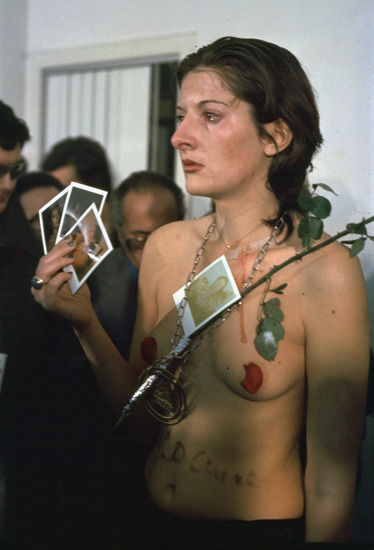
This train of thought reminded me of the performance artist Marina Abramović. In 1974 she performed Rythm 0 as part of a series. From Wikipedia:

To test the limits of the relationship between performer and audience, Abramović developed one of her most challenging (and best-known) performances. She assigned a passive role to herself, with the public being the force which would act on her.
Abramović had placed upon a table 72 objects that people were allowed to use (a sign informed them) in any way that they chose. Some of these were objects that could give pleasure, while others could be wielded to inflict pain, or to harm her. Among them were a rose, a feather, honey, a whip, scissors, a scalpel, a gun and a single bullet. For six hours the artist allowed the audience members to manipulate her body and actions.
Initially, members of the audience reacted with caution and modesty, but as time passed (and the artist remained impassive) people began to act more aggressively. As Abramović described it later:
“What I learned was that... if you leave it up to the audience, they can kill you.” ... “I felt really violated: they cut up my clothes, stuck rose thorns in my stomach, one person aimed the gun at my head, and another took it away. It created an aggressive atmosphere. After exactly 6 hours, as planned, I stood up and started walking toward the audience. Everyone ran away, to escape an actual confrontation.”

This piece is eye opening! Abramović dehumanizes herself and very quickly the audience resorts to aggression. I wonder what would've happened if the performer was a man. Would the audience have been as quick to be violent as with Abramović? And what type of aggression would they have used? Would they have cut off his clothes and stuck thorns on his stomach? Would they have stopped when he started crying?


Sometimes I feel like I'm fighting against these huge insane unchangeable things. I wonder what Alice Paul felt when she was arguing for a federal amendment to the Constitution. I feel like people I talk to about this look at me like Carrie Chapman Catt would look at Alice Paul. Something on the lines of: are you fucking insane?

But Alice Paul did it, guys. She also had a strong group of people who believed in her and her cause and she was smart and had experiences that I will never have. And a looooong legacy of women fighting for the same specific cause.
Do I have all these women in my corner to fight the social inequalities we are plagued with? Will we ever be able to have maternal AND paternal leave? To be treated equally on the war front? Will we ever be paid the same as men for the same job? Will we ever be treated like sentient beings instead of money spending machines? Is it possible to change?

Friday, March 8, 2013

Can Feminists Be Happy?

I've been asking myself that recently. 
According to this article, no. To be fair, this article also states that: "A woman who takes joy in the health, love, and growth of her children? Not a feminist.", so clearly the author doesn't understand what feminism is. And he is in the same metaphoric boat as many others, because what feminism is and means and wants has been attacked for centuries.
 

So, if we are to believe the propaganda and what the different media outlets have been feeding us, then no, feminist cannot be happy. But if we dig a little deeper we realise that these depictions are characters - they are not real. Anita Sarkeesian calls them Straw Feminists:


By turning feminism into the opposite of chauvinism not only does one prove that they don't know what feminism means, they also prove to have no media literacy at all. And a general sense of ignorance that particularly irritates me.

"you wanna rephrase that, punk?

They miss the point by a gazillion km and oversimplify a very complex issue. And that's not only true for feminism but for every aspect of life, even established dual categories such as people's sex.
And that's the problem, our inherent need to categorize everything to the point of ridiculousness. Our brains naturally categorize sensory input because otherwise it would collapse. We use categorizations to process all the information and react rapidly to every situation. Stereotypes are a product of this process. 
So when mass media outlets use these stereotypes or construe new stereotypes and feed them to everyone, indiscriminately, they perpetuate the "othering" of feminism.
The sad part is that social equality is beneficial (and necessary) to both women and men.


So maybe it's not "can feminists be happy?", maybe it's "can we be happy?"as part of a collective of people ruled by a minority that purposely oppresses the rest? Because to be honest, in this system, no one wins - not even men.

They figured it out: media is the most powerful indoctrinating tool.

Although I believe happiness comes from within and our own ability to put specific situations we find ourselves in into perspective, I wonder if actively pursuing social justice and equality would make me the most miserable person on Earth.

But if I didn't, wouldn't I be equally miserable? Is this the result of tireless efforts to suppress our desire to fight back by the media conglomerates? 


Thursday, February 28, 2013

The Elusive Alpha Female

Recently, my roommate Crystal, Nick, and I had a conversation about alpha males.
We tried to delineate what characteristics an alpha male possesses, keeping in mind that the idea comes from the animal kingdom (or a fantasy of how the animal kingdom works). Is the alpha male aggressive? Is he always in control? is he charismatic? a good speaker? heterosexual or homosexual? bisexual? is he rich? does he get laid when he's not busy being alpha somewhere else?
We conformed with equating the alpha male with the dominant male and so, their traits are the same:
  • Powerful
  • Wealthy
  • Influential
  • Attractive
  • Heterosexual
  • Objectifies women
So then, can women be alphas too?
What does a woman alpha need to be? Can we extrapolate "alphaness", or is it sex-specific?
 I read an article that suggests that high heels suggest status:

"Certain class advantages make it easier for upper middle class and wealthy women to don high heels.  High heels can really only be worn routinely by women who don't work on their feet all day (I'll grant there are dedicated exceptions).  Valet parking makes it a whole lot easier to wear shoes that hurt to walk in, so does not having to take the bus.* Having money, in itself, means that nothing stands between you and buying things that are impractical."

But heels didn't start being shoes for women. Heels started as riding shoes for men and then evolved into status wear, until the Enlightenment. Then, the discomfort of heels was left to women.
So nowadays, women show power by wearing 6 inch heels, instead of a sleek leather belt. 

Two days ago, PBS ran a documentary called Makers: Women Who Make America. Not only is it super inspiring, these women explain one by one the hardships they had fighting, what we now see as, an incredibly backwards patriarchal system. NB: what if what we now see as fair and egalitarian is actually not? Seriously think about this. Because back in the 1920s people still believed women were rendered incapacitated during their period. As in once a month for a full week.  As in out of 52 weeks, you spend 12 in bed because you're a useless individual.
 

Crystal thought for a second and said: what about Lara Croft? Or River Song? or Buffy the Vampire Slayer? or Anita Blake?
Honestly, from that list I only know Lara Croft and Buffy and I only played a Tomb Raider game over one summer (and I can't even name it) and I've seen a handful of episodes of Buffy. But I get what she meant. I also get that these characters are not exactly pushing for equality. Although they are somewhat, and in varying degrees, positive in depicting capable women that, you know, do their thing, they aren't something we should strive for or settle on. It's not a matter of making women fighters in media, it's about making them fighters without having to take their clothes off or without them always being white or well off or fulfilling some sort of sexual fantasy. And making them fighters without using violence, but that's just my personal taste.

So what do you think? Can we abstract "alphaness" or is it an archaic notion?

In case of absolute despair, look at this.


Thursday, February 14, 2013

The men of Revenge

Revenge is a fairly new (currently airing the 2nd season) show on ABC that stars a young woman, Amanda Clarke, as the daughter of a wrongfully convicted man.
After turning 21, she reinvents herself to become Emily Thorne and spends the rest of her time exerting revenge on all the people that were involved in her father's imprisonment and murder.*


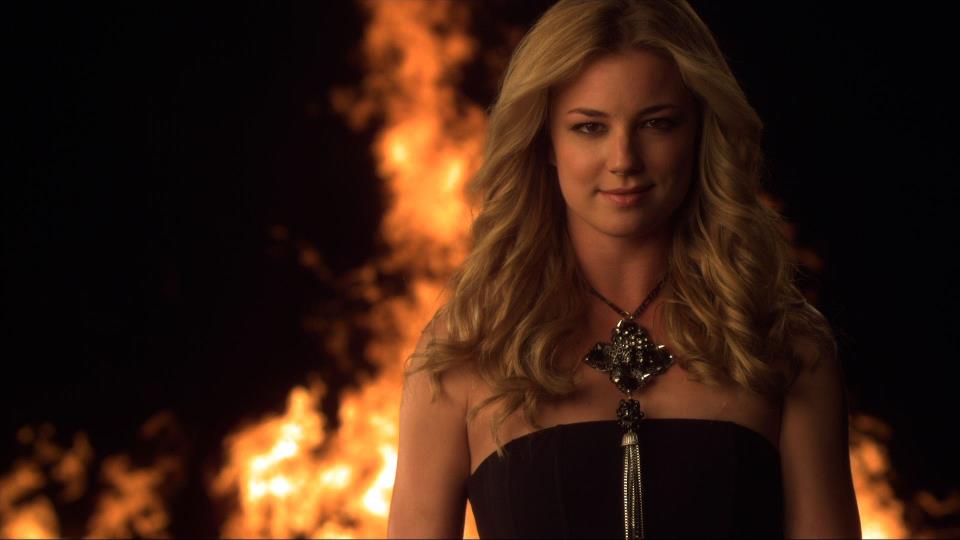
Dun dun dunnn: Emily just put a house on fire and looked glam while she did it


Although I absolutely LOVE watching this show, there are a few things that bother me.
For example, the lack of black people on the cast. Or the representation of homosexuality (hint: it's the only male that wears pink). Or the relationships that Emily has with her romantic interests. Or the stereotypes thrown left and right. Or the relationships between the men in the show.

Thorne...get it?

There are four main male characters worth talking about. In alphabetical order:

Aiden: Aiden is a new character and Emily's new love interest. We don't know a lot about his background (oooh! mysterious!) but we do know that he is violent, that he went to revenge training with Emily and that he has a British accent. Jean Kilbourne talks about this kind of character in Killing Us Softly 4 (around min. 40).


Daniel: Daniel is the wealthy son of Emily's targets. He is seen as the main man until Emily and his parents start manipulating him and he starts looking like a fool and an idiot. No amount of muscle or cash can compensate! In a sense, Emily is superior to him because she also has the money, and the body but, on top of that, she has more influence and wit. So Daniel becomes a pawn in her plot to bring his family down and stops being a romantic interest.

I hope he keeps that attitude when he finds out that his life = lies


Jack: Jack is Emily's old flame from the past. He is broke as a joke and keeps making very stupid decisions. But they are out of desperation, not for lack of intelligence. No one that good looking can be true working class and that's why even with dialogue about money trouble, the public never sees it.


Nolan: Nolan is the only guy in Emily's age range that doesn't want to sleep with her. So they made him scrawny, nerdy and gay. Problem solved! He owns a tech company that is very successful and still manages to be Emily's unpaid IT guy. Since they don't have a romantic interest in each other, their relationship has to be based off something else to push the plot forward, so it's driven by a promise made to her father that Nolan would take care of her. 


Like many other LGBT characters, Nolan was the comic relief...until he started adapting more into the heterosexual norms. During season two he becomes romantically involved with a woman and his character becomes more serious.


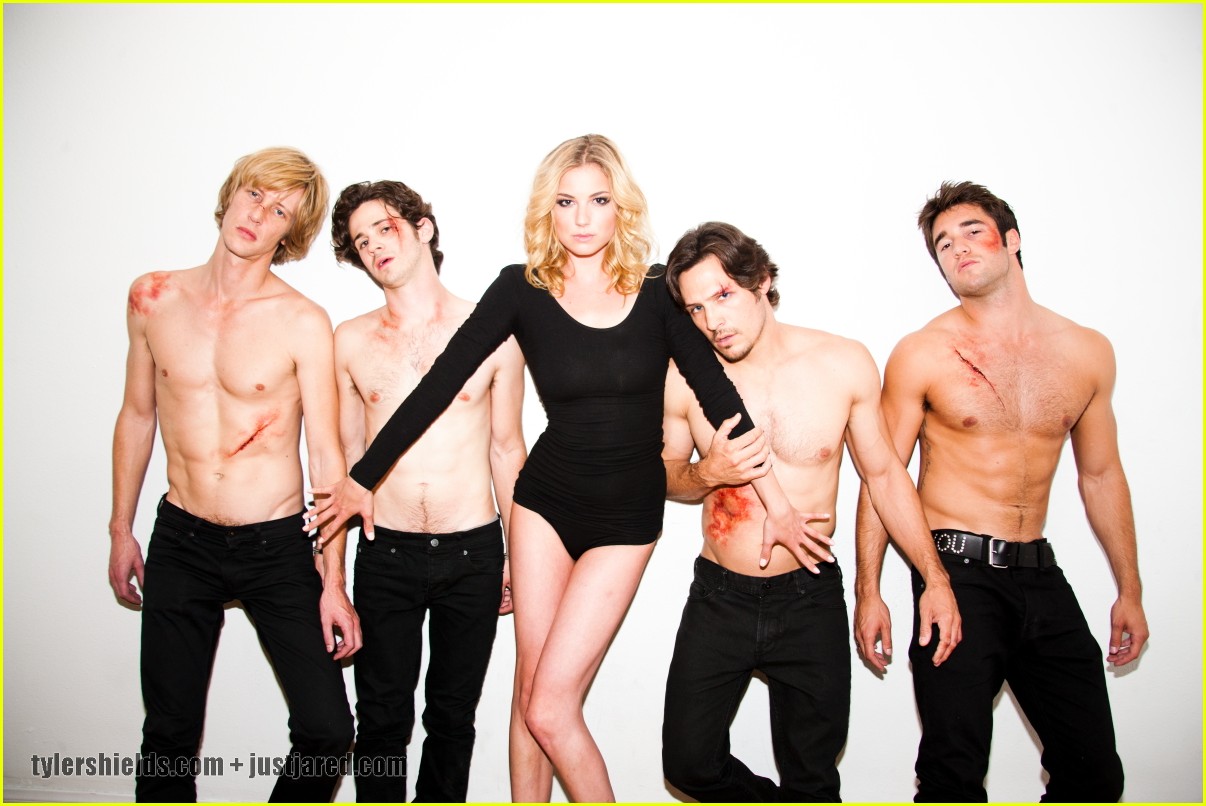
From left to right: Nolan, Declan, Emily, Jack and Daniel. Violence and nudity = successful TV show!
Since manliness is demonstrated with toughness, how they are violent becomes part of the characters personality.
Nolan is against violence, Jack is physical, Daniel uses guns and Aiden uses both.
Since Nolan is the submissive male and gay, his pacifism is unquestioned. Jack, being a blue collar guy, is rough and barbaric; while Daniel, being privileged, uses a revolver. Guns are a upper class weapon symbol because they inflict pain in such a removed, "civilized"way. Aiden is the ambivalent one - his accent brings forth stereotypes of lower class English people, but also exoticism. He is able to walk both worlds (just like Emily).


Emily needs and uses these men to get to the final goal - these men are necessary to get to a woman that they surround.

And Madeleine Stowe is fantastic


 However cliché the underlying current of the plot is, this show is more than redundancy of the stereotypes and plot lines that have been thrown at us ad nauseam by the networks. Because otherwise - I'd like to believe - it wouldn't have an audience. Emily is a modern character that follows some of the traditional dogma that is taught to girls, but she is still the main protagonist and heroine, independent, smart,  resourceful, well connected through her own abilities, and financially savvy.

Cheers to the modern woman!

*Looking for a cool clip to add to this post, I saw a panel where they said that if they can revive the father, they will. Expect it for season 4 or 5, when they start running out of ideas.

Thursday, February 7, 2013

Advertising and Class Relations


The other day, my boyfriend and I got into a huge discussion about the class system in America. He said that working class individuals are in and stay in precarious conditions because of a series of bad decisions and poor planning. I disagreed, saying that some people have a harder time moving up in the corporate world because there are barriers that society has set up to keep a large proportion of the population in the service of a smaller group. I pointed out that our world wouldn't work otherwise.

Just like this wouldn't work, either

After a heated argument, we decided that our different points of view were the consequence of two very different upbringings, based on two separate cultures. He is American, after all, the country that values individuality and underdog stories. I come from a culture that rose from a dictatorship and is very fond of their unions. But after seeing Class Dismissed I realize that a very specific part of culture – TV – has a critical influence over class relations. 

I won the argument!


By representing the working class as idiots and fools, and equating success with material goods, advertising companies succeed at stigmatizing being poor. More importantly, these shows survive on stereotypes that the networks and ads cultivate, such as a patriarchal society where men hold power over women. We see this in all the shows where working class families are characters. No matter how smart and capable the wife is, she is never able to succeed in life (i.e. buy things) because her husband – the one that is financially responsible for the family and main decision maker -  is a dunce. The woman holds absolutely no power over her own fate and well being. 

As in: not at all.

It’s important to be aware of what the advertising companies – through the shows we watch – are trying to sell us. Since poor people can’t afford to buy luxury items, these characters will always be criminals or losers and it will always be by their own volition. But we know better! and since we know what they are up to, we can stop agreeing with this skewed view of reality.